Food guide

Thai food: flavours, regional cuisines and the best Thai dishes

What Thai food is, why it tastes the way it does, and what to order: from Bangkok's street stalls to the curries of the south and the noodle soups of the north.

Kylian DevBy Kylian Dev

  • 16 must-try dishes
  • Spice level for each
  • Street food made easy

In short

Thai food is built on rice or noodles and on balancing sour, sweet, salty and hot in the same dish, with fresh herbs such as lemongrass, galangal, kaffir lime and Thai basil. It varies by region: herbal in the north, fiery and sour in Isan, coconut-rich in the centre, turmeric and seafood in the south. Start with pad thai, khao man gai and massaman if you are wary of heat, then move on to som tam and tom yum. Street food is where Thais eat every day: a busy stall is almost always a good, safe bet.

must-try dishes
16
regional cuisines
4
can be made vegetarian
9

Must-try dishes

16 best Thai dishes to try

Each card shows the Thai name to point at, the usual heat level, the region the dish comes from and where to try it on your trip. Heat varies a lot from one cook to the next – ask for mai phet if in doubt.

MildMediumHotVegetarian or can be made vegetarian
  • Pad thai

    Pad thai

    ผัดไทย

    Central

    Stir-fried rice noodles with egg, tofu, bean sprouts and tamarind, usually with shrimp. Sweet-sour, served with lime, peanuts and chilli flakes to season yourself.

    Veg on request
  • Som tam

    Som tam

    ส้มตำ

    Isan

    Green papaya salad pounded in a mortar with lime, fish sauce, chilli, tomato and peanuts. Fresh, crunchy and often fiery – the Isan classic eaten with sticky rice.

    Veg on request
  • Tom yum goong

    Tom yum goong

    ต้มยำกุ้ง

    Central

    Hot and sour soup with prawns, lemongrass, galangal and kaffir lime leaves. The clear version is sharp and zesty, the creamy one (nam khon) is richer.

  • Green curry

    Green curry

    แกงเขียวหวาน

    Central

    Coconut-milk curry with fresh green chilli paste, Thai aubergine and sweet basil, usually with chicken. Creamy but can be surprisingly hot.

    Veg on request
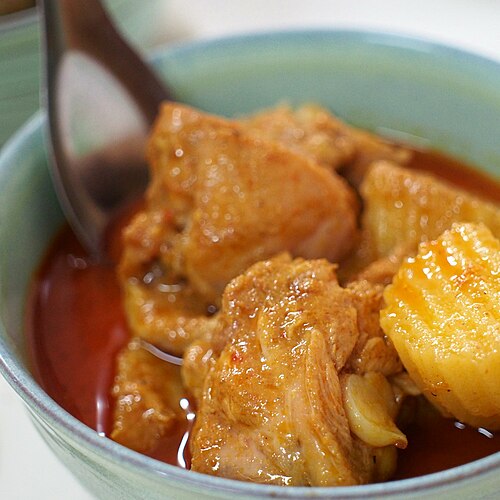
  • Massaman curry

    Massaman curry

    แกงมัสมั่น

    South

    A mellow, fragrant curry with Persian and Muslim roots: cardamom, cinnamon, potato and peanuts, often with slow-cooked beef or chicken. The gentlest curry to start with.

    Veg on request
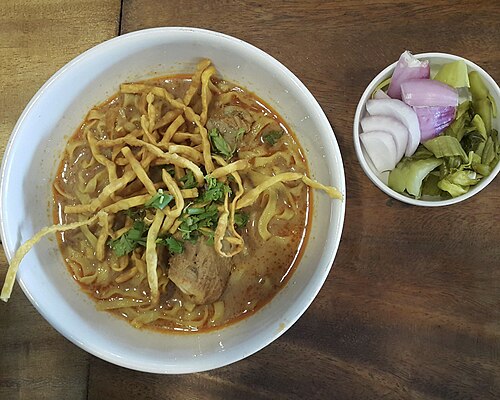
  • Khao soi

    Khao soi

    ข้าวซอย

    North

    Chiang Mai's signature: egg noodles in a coconut curry broth, topped with crispy fried noodles, with pickled mustard greens, shallots and lime on the side.

    Veg on request
  • Pad kra pao

    Pad kra pao

    ผัดกะเพรา

    Central

    Minced pork or chicken stir-fried with holy basil, garlic and lots of chilli, served on rice with a crispy fried egg (kai dao). Thailand's go-to quick lunch.

    Veg on request
    Try it inBangkok
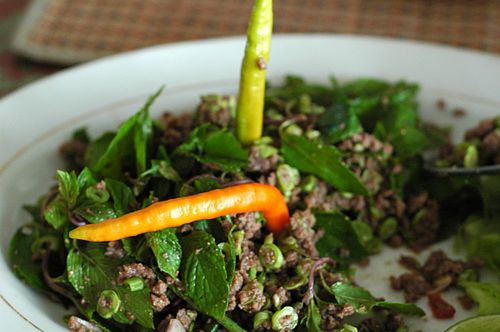
  • Larb

    Larb

    ลาบ

    Isan

    A warm salad of minced meat with lime, fish sauce, chilli, mint and toasted ground rice for crunch. Found in Isan and northern versions.

  • Khao man gai

    Khao man gai

    ข้าวมันไก่

    Central

    Poached chicken on rice cooked in chicken fat and garlic, with a clear broth and a ginger-soy-chilli sauce. Hainanese in origin, comforting and mild.

    No heat
    Try it inBangkok
  • Panang curry

    Panang curry

    พะแนง

    Central

    A thick, slightly sweet red curry with peanuts and kaffir lime leaves, less soupy than other curries. Rich rather than fiery.

    Veg on request
    Try it inKoh Tao
  • Boat noodles

    Boat noodles

    ก๋วยเตี๋ยวเรือ

    Central

    Small bowls of dark, spiced broth with rice noodles and pork or beef, once sold from boats on the canals around Ayutthaya. Locals order several bowls at once.

  • Sai oua

    Sai oua

    ไส้อั่ว

    North

    Northern grilled pork sausage packed with lemongrass, kaffir lime, galangal and chilli paste. Sold in coils at every market in Chiang Mai.

    Try it inChiang Mai
  • Gaeng som

    Gaeng som

    แกงส้ม

    South

    A sour, turmeric-yellow southern curry with fish and vegetables or bamboo shoots, without coconut milk. Tangy and one of the hottest curries.

    Try it inKhao Sok
  • Mee hokkien

    Mee hokkien

    หมี่ฮกเกี้ยน

    South

    Phuket's thick yellow noodles stir-fried with pork, seafood and greens in a savoury gravy – a legacy of the island's Hokkien Chinese community.

    Try it inPhuket
  • Mango sticky rice

    Mango sticky rice

    ข้าวเหนียวมะม่วง

    Central

    Ripe mango with glutinous rice soaked in sweet, salty coconut cream. Best during mango season, roughly March to June.

    No heatVegetarian
  • Roti

    Roti

    โรตี

    South

    A pan-fried flatbread from southern Muslim cooking, sold at stalls as a dessert with banana, egg, condensed milk or chocolate.


    No heatVegetarian

Regional cuisines

Four regions, four cuisines

Thai food changes a lot from north to south. Here is what sets each region apart, and the local specialities to look out for in each of our destinations.

North (Lanna)

Herbal, earthy, less sweet

Cooler hills, Burmese and Shan influences: curries without coconut milk, grilled sausages, chilli dips (nam prik) with raw vegetables and sticky rice eaten by hand.

  • Chiang MaiKhao Soi with mild curry and crispy noodles · Sai Oua (handmade lemongrass sausage) · Nam Prik Ong with tomatoes and fresh herbs
  • Chiang Rai & the Golden TriangleKhao Soi Mae Sai with mild spices · Fresh Oolong tea picked at Doi Mae Salong · Lap Mu Kua grilled with green chilli
  • PaiOrganic vegan bowls with local avocado · Handmade Shan flatbreads with black sesame · Pumpkin and coconut curry with fresh herbs
  • SukhothaiSukhothai noodles (sweet-and-sour with green beans) · Grilled pork with local spices · Rice-flour pastries with palm sugar
  • Mae Hong SonShan (Tai Yai) cuisine: hang le pork curry · Khao soi noodles · Oolong tea from Ban Rak Thai
  • NanNorthern khao soi and nam ngiao · Herb-packed sai ua sausage · Nan-style laap (spicy minced-meat salad)

Isan (north-east)

Sour, salty and very hot

Close to Lao cooking: som tam, larb, grilled chicken (gai yang) and sticky rice. Isan dishes have spread across the whole country and are sold on almost every street corner.

No destination on our map is in Isan, but its dishes are everywhere – try them at street stalls in Bangkok

Central & Bangkok

Balanced, sweeter, refined

The cuisine most people know abroad: coconut curries, tom yum, pad thai and the more elaborate 'royal' dishes from the old court, plus strong Chinese influence in the noodle shops.

  • BangkokPad Thai Thip Samai with tiger prawns · Spicy Som Tum from Silom · Mango sticky rice with coconut milk
  • AyutthayaGiant freshwater prawns grilled over wood fire · Roti Sai Mai (thin crepe wrapped around pandan candy floss) · Boat noodles in a rich, spiced broth
  • Kanchanaburi & ErawanKaeng Pa (bold jungle curry without coconut milk) · Fried catfish with red curry paste and basil · Bamboo-grilled marinated chicken
  • Hua HinSeafood platters from the Night Market · Khao Chae (chilled royal jasmine rice) · Crispy roti with banana and milk caramel
  • Koh ChangStir-fried prawns in tamarind sauce · Mangrove crab with black pepper · Fresh fruit picked from Trat's orchards
  • Koh KoodGrilled squid and fish from Ao Salad village · Seafood tom yam · Durians and rambutans from Trat's orchards (April–June)
  • Koh MakWhole fish grilled with salt and lemongrass · Green papaya salad (som tam) · Green curry with coconut milk
  • Koh SametBeach seafood barbecue · Crab in yellow curry (pu pad pong karee) · Rayong nam prik (chilli paste with dried shrimp)
  • PattayaSeafood from Naklua market · Pad thai and skewers from the night markets · Mango sticky rice
  • Khao YaiPak Chong beef steak (local dairy farms) · Farm-made yoghurt and ice cream · Som tam and gai yang from neighbouring Isan

South & islands

Seafood, turmeric, fiery

Turmeric, fresh seafood and some of the spiciest curries in the country, with Muslim influences (massaman, roti) and, in Phuket, a distinct Peranakan-Chinese tradition.

  • Koh TaoGiant grilled squid with chilli-lime sauce · Rich Panang curry with crushed peanuts · Grilled red snapper, feet in the sand, at Sairee
  • Koh PhanganGreen mango salad with dried shrimp · Banana-chocolate pancakes from Thong Sala's stalls · Ayurvedic and raw healthy food in Srithanu
  • Koh SamuiBlue crab with fresh green pepper and crispy garlic · Traditional Massaman curry slow-cooked in coconut milk · Coconut picked fresh from the tree
  • Khao SokGaeng Som (bold southern curry with bamboo shoots) · Fresh Cheow Lan lake fish grilled with wild herbs · Wild vegetables stir-fried with garlic and light soy sauce
  • PhuketMee Hokkien (thick stir-fried noodles with pork and seafood) · Kanom Jeen with mild yellow crab curry · Oh Aew (traditional refreshing dessert from Phuket Town)
  • Krabi & RailayWhole catch of the day grilled with sea salt · Massaman curry with sweet potato and cinnamon · Crispy mango-chocolate roti
  • Koh Phi PhiSpicy, lemongrass-scented Tom Yum Goong · Grilled sea bream fillets barbecued on the sand · Crispy pizzas and fresh watermelon juice
  • Koh LantaAuthentic Massaman curry with melt-in-the-mouth beef · Fresh grilled squid with garlic and coriander · Thai roti with sweetened condensed milk
  • Koh LipeMild yellow prawn curry with pineapple · Morning catch barbecued on the Walking Street · Fresh mango sliced to order
  • Khao LakSteamed fish with lime (pla neung manao) · Southern Thai kua kling curry · Seafood from Bang Niang night market
  • Koh Yao NoiSouthern sour fish curry (gaeng som) · Roti for breakfast · Prawns and crab from the bay's farms
  • Trang IslandsTrang roast pork (mu yang) · Trang breakfast dim sum · Grilled fish from Koh Muk's villages

Where to eat what

Food scene by destination

What each destination is known for food-wise, from street food and night markets to seafood and vegetarian options. Click a destination to see its full guide.

Street food & night markets

How to order street food in Thailand

Most stalls cook one or two dishes and have no English menu. It is easier than it looks.

  1. 1

    Pick a busy stall

    A queue of locals means fresh ingredients and fast turnover. Each stall usually specialises in one dish – look at what people are eating.

  2. 2

    Point and say 'ao an nee'

    Point at the dish or the ingredients on display. For noodle soups you choose the noodle type and the meat.

  3. 3

    Set the heat

    Say 'mai phet' (not spicy) or 'phet nit noi' (a little). Then adjust yourself with the condiment caddy: sugar, fish sauce, vinegar with chilli, dried chilli.

  4. 4

    Pay cash, small notes

    Most stalls take cash only, some accept Thai QR payments. Carry 20 and 100-baht notes – a 1,000 note is hard to break.

Street food hygiene tips

  • Choose food cooked to order in front of you and served hot.
  • Favour stalls with high turnover rather than dishes left sitting out.
  • Drink bottled or filtered water; ice in restaurants and busy stalls is generally factory-made.
  • Go easy on raw seafood and raw-meat dishes during the first days.
  • Peel your own fruit or buy it freshly cut in front of you.
  • Carry hand sanitiser – not every stall has somewhere to wash your hands.

What does food cost?

  • Street food dish≈ 50 – 100 ฿

    Noodles, rice dishes, skewers. A bit more in island and tourist areas.

  • Night market dish≈ 60 – 150 ฿

    Seafood and specialities cost more.

  • Local restaurant≈ 80 – 250 ฿

    Per dish, in a simple Thai restaurant.

  • Tourist or upscale restaurant≈ 250 ฿ +

    Beach restaurants, hotels, western food.

Indicative price levels only: they vary by place, season and inflation, and are always higher on islands. Convert baht to your currency

Food phrases

12 useful Thai phrases for eating out

A few words go a long way at a stall. Men end polite sentences with 'khrap', women with 'kha'.

  • mâi phèt

    ไม่เผ็ด

    Not spicy

  • phèt nít nòi

    เผ็ดนิดหน่อย

    A little spicy

  • kin jay

    กินเจ

    I eat jay (vegan, no animal products)

  • mang-sà-wí-rát

    มังสวิรัติ

    Vegetarian

  • mâi sài nám plaa

    ไม่ใส่น้ำปลา

    No fish sauce

  • mâi sài thùa

    ไม่ใส่ถั่ว

    No peanuts

  • mâi sài núea sàt

    ไม่ใส่เนื้อสัตว์

    No meat

  • ao an níi

    เอาอันนี้

    This one, please

  • nám plào

    น้ำเปล่า

    Plain water

  • à-ròi

    อร่อย

    Delicious!

  • chék bin

    เช็คบิล

    The bill, please

  • khàwp khun khráp / khâ

    ขอบคุณ ครับ / ค่ะ

    Thank you (man / woman)

Thai is a tonal language: the romanisation is approximate, so showing the Thai script is often the most reliable option.

Dietary needs

Vegetarian, vegan and allergies in Thailand

Eating vegetarian is easy in tourist areas and doable elsewhere, as long as you know that fish sauce, shrimp paste and oyster sauce are in many dishes.

Vegetarian (mangsawirat)

Most stir-fries, curries and fried rice can be made with tofu or vegetables. Ask for no meat and no fish sauce: 'mai sai nuea sat, mai sai nam plaa'.

Jay: the vegan option

Jay (เจ) food is Buddhist-Chinese and free of all animal products (and traditionally garlic and onion). Look for yellow flags with red lettering; there is a big jay festival every autumn.

Gluten-free

Rice and rice noodles are naturally gluten-free, but soy, oyster and some seasoning sauces often contain wheat. Grilled dishes and plain curries are safer choices.

Serious allergies: be cautious

Peanuts, shellfish, fish sauce and shrimp paste are very common, woks are shared and stall cooks may not understand the risk. Carry a written allergy card in Thai, keep your medication with you and prefer restaurants where you can speak with staff. This is general advice, not medical guidance; see also our Thailand health and vaccines guide.

For food lovers

Three food capitals to plan your trip around

Travelling on a budget or with children? See our guides: backpacking Thailand · Thailand with kids

FAQ

Thai food: your questions answered

What are the must-try dishes in Thailand?

Pad thai, som tam (papaya salad), tom yum goong, green curry, massaman curry, khao soi in the north, pad kra pao and mango sticky rice for dessert. Add larb and khao man gai for a good overview of everyday Thai food.

Is Thai food very spicy?

It can be, especially Isan and southern dishes. But many dishes are mild (pad thai, khao man gai, massaman), and cooks will happily tone it down if you say 'mai phet'. Chilli is often added to taste at the table.

Is street food safe in Thailand?

Generally yes, and it is where Thais eat daily. Choose busy stalls, food cooked to order and served hot, and drink bottled water. Upset stomachs happen, usually more from change of diet than hygiene.

How much does a meal cost in Thailand?

As a rough guide, a street food dish costs around 50 to 100 baht, a dish in a simple local restaurant 80 to 250 baht, and more in tourist areas and on islands. Prices vary with location and season. For a full daily budget, see our Thailand travel budget guide or the trip budget calculator.

Is it easy to eat vegetarian or vegan in Thailand?

Fairly easy in cities and tourist areas, especially Chiang Mai, Pai and Koh Phangan. Elsewhere, ask for tofu, no meat and no fish sauce, or look for jay (vegan) restaurants with yellow flags.

What is the difference between northern and southern Thai food?

Northern Thailand (Lanna) food is herbal and less sweet, with sticky rice, sausages and curries without coconut milk, like khao soi. Southern food uses turmeric and seafood, with some of the hottest curries in the country, and Muslim influences such as massaman and roti.

Can I drink tap water or have ice?

Tap water is not usually drunk: use bottled or filtered water, widely available and cheap. Ice served in restaurants and busy stalls is generally factory-made tube ice and is commonly considered safe.

What is Thai food?

Thai food is the cuisine of Thailand, based on rice (sticky rice in the north and north-east) and noodles, eaten with curries, soups, stir-fries, salads and grilled dishes that are shared at the table. Key ingredients are fish sauce, chilli, lime, palm sugar, garlic and fresh herbs, with influences from China, India, Laos and Malaysia depending on the region.

What does Thai food taste like?

The signature is balance: most dishes combine sour (lime, tamarind), sweet (palm sugar), salty (fish sauce) and hot (chilli), often with a bitter or herbal note. Many tables also carry a condiment set (sugar, chilli flakes, fish sauce with chilli, vinegar) so you adjust the flavour yourself.

What is the most popular Thai dish?

Abroad, pad thai, green curry and tom yum goong are the best-known Thai dishes. In Thailand itself, everyday favourites include pad kra pao (holy basil stir-fry with rice and fried egg), khao man gai, som tam and noodle soups.

What is the best Thai food for beginners?

Mild dishes such as pad thai, khao man gai, massaman curry, panang curry and mango sticky rice are good first choices. Ask for 'mai phet' (not spicy) and add chilli from the condiment set if you want more heat.

Plan your trip