
 By Kylian Dev
What is the daily budget for Thailand by travel style?
The figures below are per person, based on two people sharing a room, and include accommodation, food, local transport and a moderate amount of activities. Solo travellers should add 20 to 40 percent, mostly because rooms cost the same for one or two. Conversion is based on roughly 37 THB to 1 EUR; check the current rate before you go.
| Travel style | Per day (THB) | Per day (EUR) | What it looks like |
|---|---|---|---|
| Backpacker | 1,000 to 1,500 | 27 to 40 | Dorm or basic fan room, street food, buses and shared songthaews, few paid tours |
| Mid-range | 2,000 to 3,500 | 55 to 95 | Air-conditioned hotel with pool, mix of street food and restaurants, some tours, occasional domestic flight |
| Comfort | 5,000 and up | 135 and up | Boutique or resort hotels, restaurant meals, private transfers, diving or private tours |
To turn these ranges into a figure for your own dates and route, use the budget calculator on this site: it lets you pick destinations, number of days and travel style and returns an estimate per person.
Typical prices in Thailand: what things actually cost
| Item | Typical price (THB) | Approx. EUR |
|---|---|---|
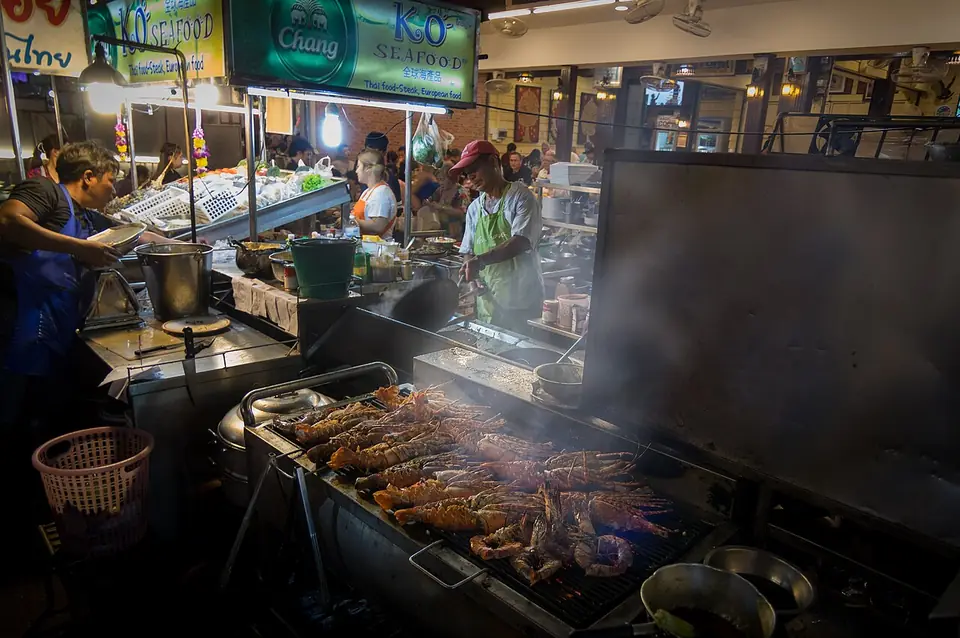
| Street food dish (pad thai, rice with basil pork) | 50 to 100 | 1.50 to 3 |
| Meal in a local restaurant | 100 to 250 | 3 to 7 |
| Meal in a tourist-area restaurant | 250 to 600 | 7 to 16 |
| Water 1.5 L at 7-Eleven | 14 to 20 | 0.40 to 0.55 |
| Large local beer (shop / bar) | 60 to 90 / 90 to 180 | 2 to 5 |
| One-hour Thai massage | 250 to 450 | 7 to 12 |
| Scooter rental per day | 200 to 350 | 5.50 to 9.50 |
| Shared songthaew ride in town | 20 to 50 | 0.50 to 1.50 |
| Grab ride across central Bangkok | 80 to 250 | 2 to 7 |
| BTS Skytrain single ticket | 17 to 65 | 0.50 to 1.80 |
| Night bus Bangkok to Chiang Mai (VIP) | 550 to 900 | 15 to 25 |
| Night train Bangkok to Chiang Mai (2nd class sleeper) | 900 to 1,600 | 25 to 43 |
| Domestic flight booked in advance | 1,000 to 3,000 | 27 to 80 |
| Ferry to the islands (per leg) | 300 to 1,500 | 8 to 40 |
| National park entry fee (foreigners) | 100 to 500 | 3 to 14 |
| PADI or SSI Open Water course on Koh Tao | 10,000 to 13,000 | 300 to 400 |
How much does accommodation cost in Thailand?
Accommodation is the item that varies most, and the one where location matters more than comfort level. The same standard of room can cost twice as much on Koh Phi Phi as in Chiang Mai.
| Tier | Price per night (THB) | Approx. EUR |
|---|---|---|
| Hostel dorm bed | 250 to 500 | 7 to 14 |
| Basic guesthouse, private room | 500 to 1,000 | 14 to 27 |
| Mid-range hotel with air conditioning and pool | 1,000 to 2,500 | 27 to 68 |
| Upmarket or boutique hotel | 3,000 to 8,000 | 80 to 215 |
| Beach resort, high season | 8,000 and up | 215 and up |
- In high season on the islands, cheap rooms sell out first; book the first nights ahead.
- Beachfront means a clear premium; a 5 to 10 minute walk inland often saves 30 percent or more.
- Longer stays of a week or more can often be negotiated directly with guesthouses.
Islands, Bangkok or the north: where is Thailand cheapest?
Islands and Phuket
Most expensiveKoh Samui, Phuket, Koh Phi Phi and Koh Tao are the most expensive areas: food, rooms and boat transport add up. Expect 20 to 50 percent above mainland prices.
Bangkok
MidAccommodation is good value for the quality, and street food and public transport are cheap. Rooftop bars, shopping malls and nightlife are where the budget slips.
North (Chiang Mai, Pai, Chiang Rai)
CheapestThe cheapest region for comparable comfort: good guesthouses, cheap meals, affordable cooking classes and trekking.
Northeast and lesser-known provinces
Very cheapIsan, Nan or Trang see few foreign visitors, so prices are local prices. Transport can take longer, which is the real cost.
A route that combines a week in the north with a week on the islands balances the budget well: you save in the north what you spend at the beach.
Sample budgets for 2 weeks and 3 weeks in Thailand
The totals below are per person, on the ground, excluding international flights and travel insurance. They assume a classic route such as Bangkok, the north and one island group, with one or two domestic flights or night trains.
| Trip length | Backpacker | Mid-range | Comfort |
|---|---|---|---|
| 2 weeks | 450 to 650 EUR | 900 to 1,400 EUR | 2,000 EUR and up |
| 3 weeks | 650 to 950 EUR | 1,300 to 2,000 EUR | 3,000 EUR and up |
Return flights from Europe to Bangkok usually fall somewhere between 550 and 1,100 EUR in economy, with the higher end around Christmas, New Year and European summer holidays. This is a broad indicative range: routes, stopovers and booking time make a large difference.
Budget for 2 weeks in Thailand (and 10 to 15 days)
For 14 to 15 days on a classic Bangkok, north and islands route, the totals below are per person, excluding international flights and insurance, based on the daily budgets above and about 37 THB to 1 EUR. For a 10-day trip, count roughly 350 to 500 EUR as a backpacker, 650 to 1,050 EUR mid-range and 1,400 EUR and up in comfort.
| Style (per person) | Total (THB) | Total (EUR) |
|---|---|---|
| Backpacker | 16,500 to 24,000 | 450 to 650 |
| Mid-range | 33,500 to 52,000 | 900 to 1,400 |
| Comfort | 74,000 and up | 2,000 and up |
Budget for 3 weeks in Thailand
Three weeks allow a slower pace and often a cheaper daily average, since you spend longer in each place. Totals per person, excluding international flights and insurance.
| Style (per person) | Total (THB) | Total (EUR) |
|---|---|---|
| Backpacker | 24,000 to 35,000 | 650 to 950 |
| Mid-range | 48,000 to 74,000 | 1,300 to 2,000 |
| Comfort | 111,000 and up | 3,000 and up |
Budget for 1 month in Thailand
Over a month, the daily budget matters more than transport: staying a week or more in the north or on a quieter island keeps the total down. Totals per person for about 30 days, excluding international flights and insurance, extrapolated from the daily budgets above.
| Style (per person) | Total (THB) | Total (EUR) |
|---|---|---|
| Backpacker | 31,500 to 46,000 | 850 to 1,250 |
| Mid-range | 65,000 to 103,500 | 1,750 to 2,800 |
| Comfort | 148,000 and up | 4,000 and up |
High season vs low season: how much difference does it make?
High season runs roughly from November to March, with peaks at Christmas, New Year and Chinese New Year. Accommodation prices rise most, by 30 to 100 percent in popular beach areas, while food and transport change little.
- High season (Nov to Mar): best weather in most of the country, highest room prices, book ahead for islands.
- Hot season (Mar to May): still busy on the islands, prices start to ease; Songkran in April pushes up prices briefly.
- Rainy season (Jun to Oct): lower room rates and discounts on resorts, but some boat routes and marine parks are reduced or closed.
- The Gulf islands (Samui, Phangan, Tao) have a different pattern, with their main rains around October to December.
How to save money in Thailand
- Take night trains or night buses on long routes: you save a night of accommodation.
- Eat where Thai people eat: markets, food courts in malls and street stalls are cheaper and often better.
- Buy combined bus and ferry tickets (joint tickets) for island transfers rather than separate legs.
- Avoid restaurants on the main tourist strips; one street back, prices often drop by a third.
- Travel in shoulder season (April to June or October) for lower room rates with acceptable weather.
- Use Grab or Bolt in cities instead of negotiating with tuk-tuks.
- Buy a local SIM or eSIM at the airport or a shop rather than roaming.
- Do not exchange money at airport counters for large sums; rates are better in town.
- Do not accept dynamic currency conversion at ATMs or card terminals: always pay in THB.